

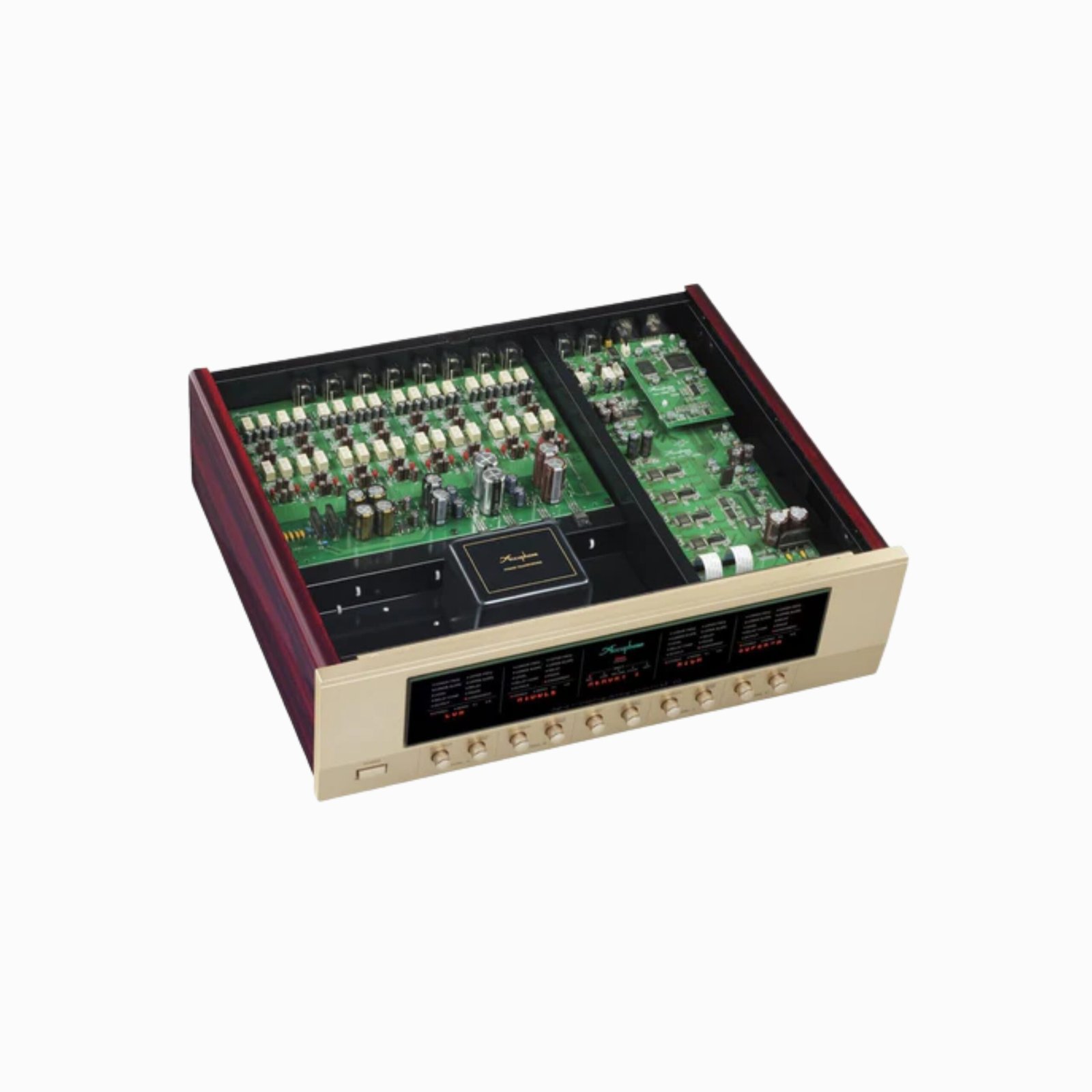
Description
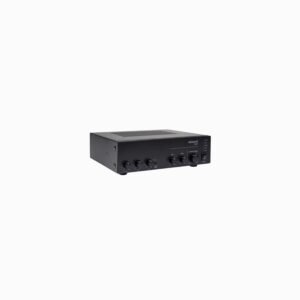
The Digital Frequency Dividing Network DF-65 harnesses the very best of digital technology in every aspect, including a high-speed 40-bit floating point DSP. The standard unit configuration supports signal processing for up to four-way systems. Highly accurate digital filters offer a choice of 59 cutoff frequency points and up to 96 dB/octave attenuation. Integrated time alignment function adjustable in 0.5-cm steps, and a delay compensator for automatically offsetting any filter circuit delays. Monophonic output mode provides high versatility for various configurations.
Warranty:
1-year manufacturer’s warranty
Features:
- High-speed DSP realizes fully digital signal processing in channel divider units
- The standard configuration allows a 4-channel (4-way) system setup
- 59 selectable cutoff frequency points
- Highly accurate 96 dB/oct attenuation slope
- The time alignment function allows delay time setting in 0.5-cm steps
- Delay compensator offsets signal delays in filter circuitry
- Further refined MDS++ D/A converter
- Selectable monophonic output mode for further enhanced specifications
High-speed, high-precision DSP implements fully digital signal processing. Designed to serve as the core component of a multi-amp system, the channel divider DF-65 features high-speed digital signal processing with amazing power. The latest digital circuit topology and advanced technology come together in a floating-point DSP that has a 32-bit mantissa and 8-bit exponent section, serving as a digital filter. The division into mantissa and exponent prevents errors even when handling very small values. This results in dramatically improved dynamic range and superior precision, allowing very steep cut-off slope settings of 48 dB or 96 dB per octave. All other functions, including phase, delay, and level control, are also implemented in the digital domain. The result is ultra-precise filtering free from the adverse effects of temperature changes or aging.
59 selectable cut-off frequency points. Filter frequency points can be set over the range from 31.5 Hz to 22.4 kHz in 1/6-octave intervals. In addition, 10, 20, and 290 Hz points are also provided, resulting in a total of 59 points. Each divider unit is fully flexible and allows independent selection of lower and upper cut-off frequencies.
Six filter slope characteristics with up to 96 dB attenuation per octave. The filter attenuation characteristics can be set to 6 dB, 12 dB, 18 dB, 24 dB, 48 dB, or 96 dB per octave. The 96 dB/octave setting in particular allows the driver unit to reproduce only its intended frequency without being affected by adjacent frequency bands. This makes it possible to create a multi-amp system that takes musical accuracy to a wholly new level.
Technical Specifications:
| Digital Inputs | COAXIAL
Format: IEC 60958/AES3 compliant Sampling frequencies 32 kHz to 192 kHz (16 to 24 bits, 2-channel PCM) OPTICAL Format: JEITA CP-1212 Sampling frequencies 32 kHz to 96 kHz (16 to 24 bits, 2-channel PCM) HS-LINK Connector: RJ-45, HS-LINK cable Ver. 1 Sampling frequencies 32 kHz to 192 kHz (24 bits, 2-channel PCM) Ver. 2 Sampling frequencies 32 kHz to 384 kHz (32 bits, 2-channel PCM) (352.8 kHz and 384 kHz are converted to 176.4 kHz and 192 kHz, respectively.) |
| Analog Input | Maximum Input Level 3.7 V (1 kHz, 2.5 V output) Input Impedance BALANCED: 40 kilohms LINE: 20 kilohms
A/D converter Principle 1-bit delta sigma modulation Sample Frequency 176.4kHz Quantization 24bitz |
| Digital Output | HS-LINK Connector: RJ-45, dedicated HS-LINK cable |
| Frequency Response | 2.0 to 50,000 Hz +0 –3 dB |
| D/A Converter | Quantization
32 bits STEREO Operation 4MDS++ type MONO Operation 8MDS++ type |
| THD | 0.0007% (20 to 20,000 Hz) |
| S/N Ratio | STEREO Operation MONO Operation COAXIAL / OPTICAL 121 dB 123 dB HS-LINK 121 dB 123 dB Analog Input 116 dB 117 dB |
| Dynamic Range | 118 dB |
| Channel Separation | 108 dB (20 to 20,000 Hz) |
| Slope Characteristics | 6 dB/octave, 12 dB/octave, 18 dB/octave
24 dB/octave, 48 dB/octave, 96 dB/octave *When the cutoff frequency is 10 Hz: 48 dB/octave, 96 dB/octave is not available 20 Hz: 96 dB/octave not available |
| Delay (converted into distance) | 0 to ±3,000 cm (0.5-cm steps)
* Independent settings for left and right are possible. * Delay value range limit (absolute value) for all channels is 3,000 cm |
| Level Adjustment Range | “Analog ATT” OFF: –40 to + 12.0 dB (0.1-dB steps) “Analog ATT” ON: –50 to + 2.0 dB (0.1-dB steps)
*Independent settings for left and right are possible. |
| Output
Voltage/ Output Impedance |
BALANCED:
2.5 V, 50 ohms, balanced XLR connector LINE: 2.5 V, 50 ohms, RCA-type phono connector |
| Minimum Load Impedance | BALANCED/LINE 600 ohms |
| Power Requirements | 120/220/230 V AC, 50/60 Hz |
| Power Consumption | 31 watts |
| Maximum Dimensions | Width 465 mm (18.31˝)
Height 151 mm (15.95˝) Depth 396 mm (15.59˝) |
| Mass | 15.1 kg (33.3 lbs) net
21.0 kg (46.3 lbs) in shipping carton |