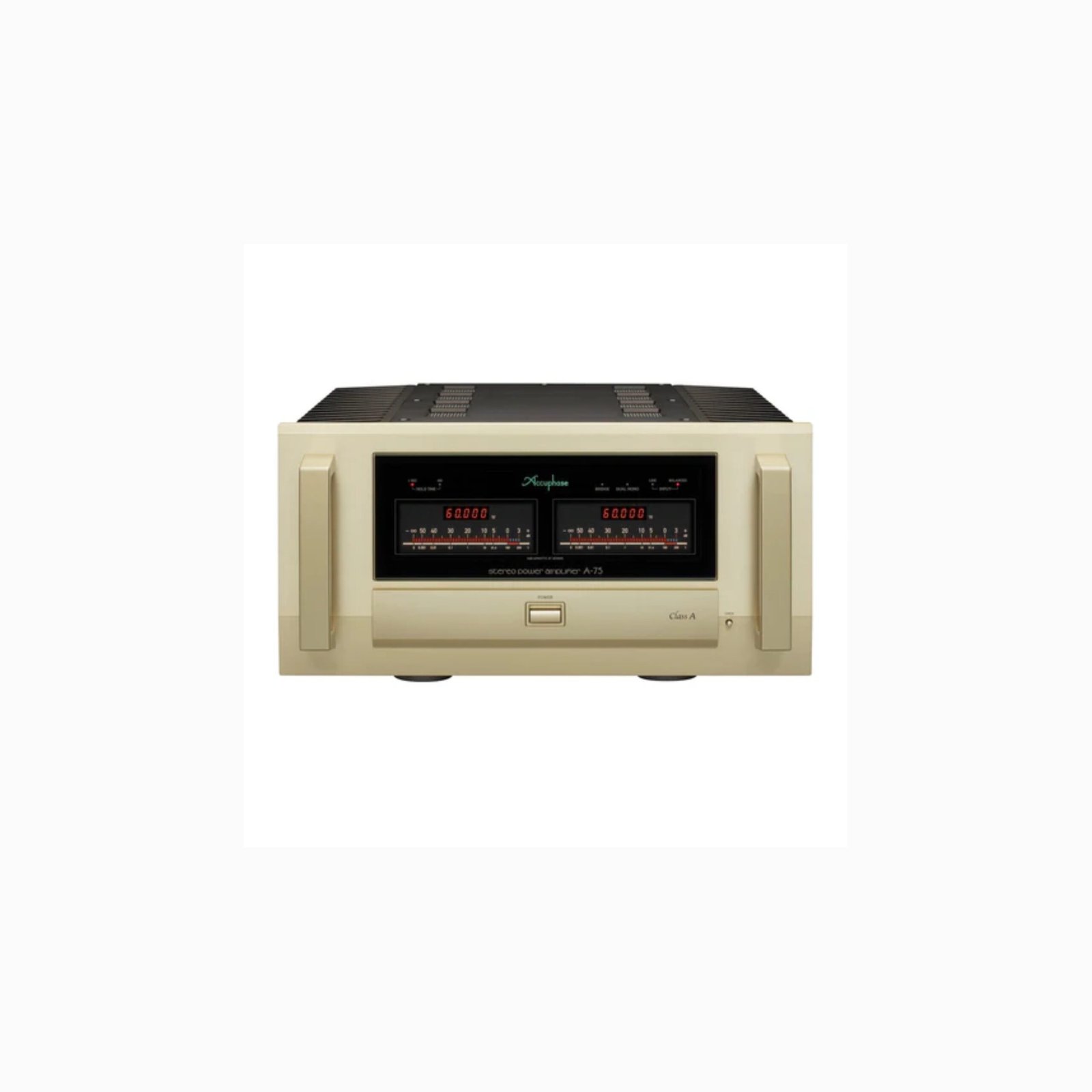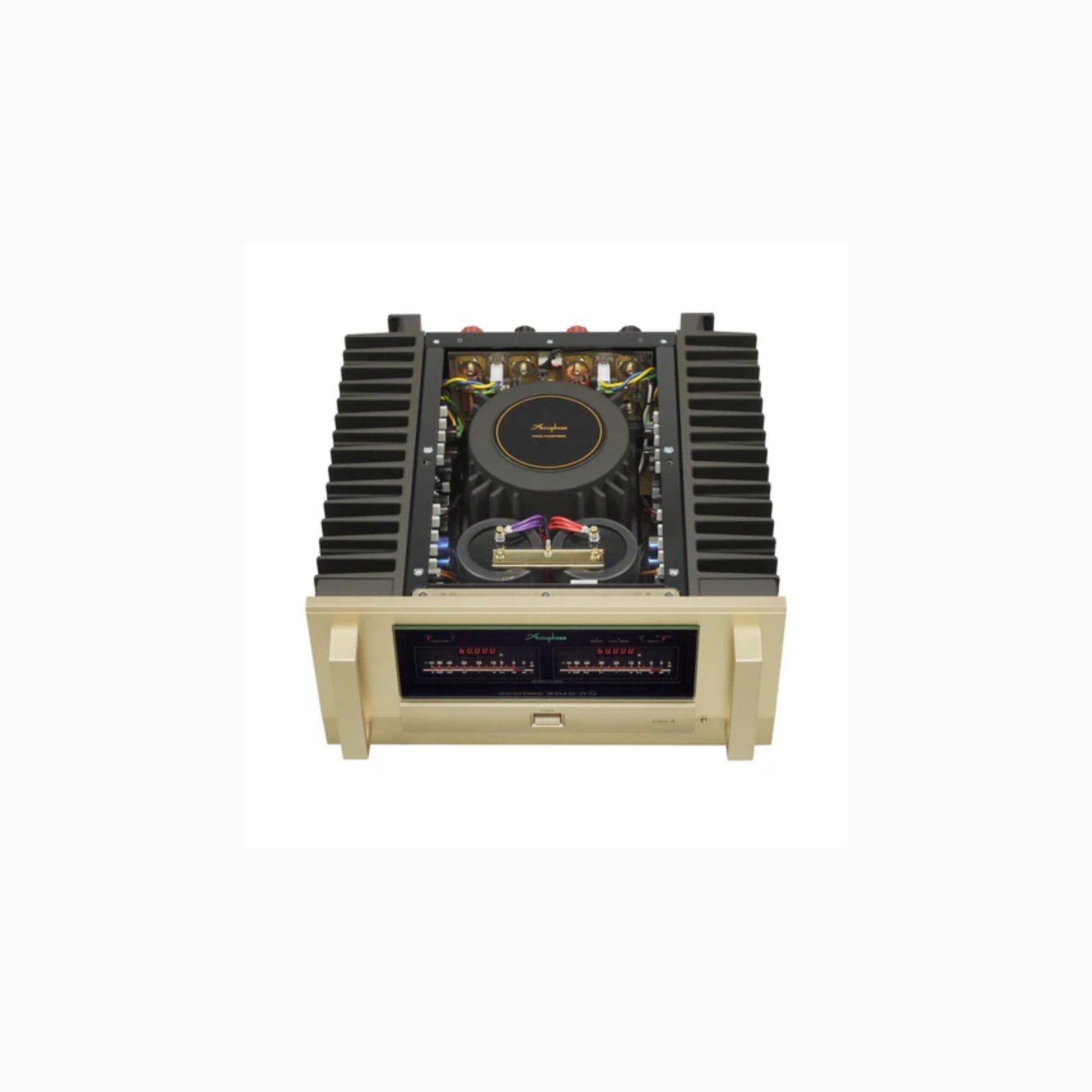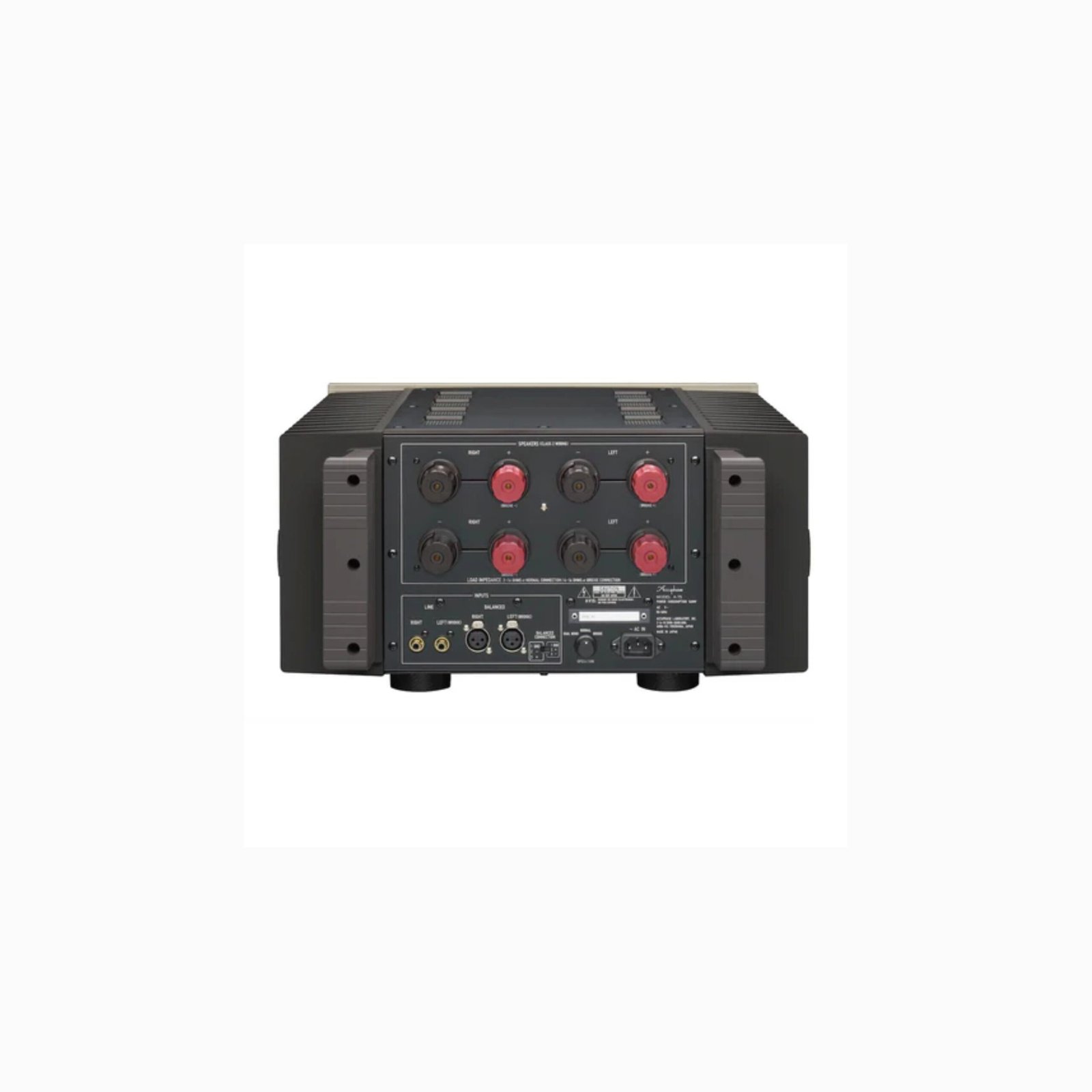
Instrumentation amplifier topology using discrete semiconductors realizes ideal gain allocation. Balanced Remote Sensing optimizes the efficiency of negative feedback. 10-parallel push-pull configuration in the power amplification stage. The overall result is an outstanding S/N ratio and amazingly high damping factor. Furthermore, a constant-voltage drive handles even drastic speaker impedance fluctuations with ease. Power MOS-FETs and other carefully selected components and materials make this Pure Class A Stereo Power Amplifier a sheer delight to experience.

Warranty:

1-year manufacturer’s warranty

Features:

  • Pure Class A stereo power amplifier with outstanding S/N ratio and very high damping factor
  • Rated for 60 watts into 8 ohms and 480 watts into 1 ohm
  • Power MOS-FETs in a 10-parallel push-pull configuration
  • Instrumentation amplifier principle
  • All signal paths are realized with discrete semiconductor components
  • Balanced Remote Sensing principle
  • MCS+ circuit topology
  • Current feedback amplification principle
  • Digital power value readout and bar graph voltage indication
  • Support for bi-amping and bridged mode

High S/N ratio results in sparkling clarity
The A-75 uses a balanced instrumentation amplifier circuit configuration throughout all amplification stages, minimizing susceptibility to noise and ensuring outstanding characteristics. The signal input stage is configured with discrete semiconductors as a push-pull circuit. This makes it possible to allocate a high gain of 22 dB (factor of approx. 12.6) to this section and conversely keep the gain of the power amplification section to a low 6 dB (approx. x2.0). As a result, even large signal amplitudes are conveyed accurately from the signal input stage to the power amplification stage, and noise components processed in the amplification stage are kept low. Compared to the previous model, this results in a noise reduction of 11%. S/N ratio is rated at an astonishing 122 dB (at max gain setting), which manifests itself in superb sonic clarity.

The high damping factor realizes the ideal speaker drive
To correctly track the dynamic changes in loudspeaker impedance and drive the speakers with ideal characteristics, the power amplifier output impedance needs to be kept as low as possible, which in turn means an increase in the damping factor. To achieve this aim, the A-75 not only positions the negative feedback sensing point close to the speaker terminals but also obtains sensing information from the ground line at the same time. This method is called Balanced Remote Sensing. The aim is to minimize output impedance and therefore achieve a significant increase in the damping factor. Furthermore, ten power MOS-FETs with excellent current capacity are used in a parallel configuration, and MOS-FET switches that eliminate all mechanical contacts guarantee outstanding long-term reliability. The edgewise coil with a large cross-sectional area, a Hall element for current detection, and many other sophisticated features further contribute to reduced output impedance. The result is a damping factor rating of 1,000, which represents a 25% improvement over the previous model.

Output power characteristics suitable for a constant voltage drive
A massive toroidal power transformer and large filtering capacitors (100,000 μF x 2) in the power supply ensure that plenty of power is available for handling high-amplitude input signals, and large heat sinks efficiently dissipate any excess thermal energy. As a result, the power amplification stage is rated for a continuous 60 watts into 8 ohms, 120 watts into 4 ohms, 240 watts into 2 ohms, and 480 watts into 1 ohm (music signals). This linear power progression demonstrates that a constant voltage drive has been successfully realized. The maximum output rating is 131 watts into 8 ohms, 232 watts into 4 ohms, 370 watts into 2 ohms, and 547 watts into 1 ohm (music signals). Although a Pure Class A Stereo Power Amplifier, the A-75 can easily drive even large and demanding speakers.

Technical Specifications:

Continuous Average Output power (20-20,000 Hz) Stereo Operation (both channels are driven:

480 W/ch = 1-ohms load *

240 W/ch = 2-ohms load

120 W/ch = 4-ohms load

60 W/ch = 8-ohms load

Monophonic Operation:

960 watts = 2 ohms load*

480 watts = 4 ohms load

240 watts = 8 ohms load

Notes:

Ratings marked. with * are for music signals only

Total Harmonic Distortion Stereo operation ( both channels driven )

0.07% with a 2-ohm load

0.03% with a 4 to 16-ohm load

Monophonic operation (bridged connection)

0.05% with a 4 to 16-ohm load

Intermodulation Distortion 0.01%
Frequency Response At rated continuous average output: 20 – 20 000 Hz + 0 – 0.2dB

At 1 watt output: 0.5 – 160000Hz +0 – 3.0dB

Gain 28.0dB ( GAIN selector in MAX position)

(Stereo/monophonic operation)

Gain Selector MAX – 28dB

-3dB – 25dB

-6dB – 22dB

-12dB – 16dB

Output Load Impedance Stereo Operation: 2 to 16 ohms

Monophonic Operation: 4 to 16 ohms

* With music signals only, 1-ohm loads are permissible for stereo operation and 2-ohm loads for bridged operation.

Damping factor 1 000
Input Sensitivity ( with 8-ohm load) Stereo Operation

0.87V for rated continuous average output

0.11V for 1-watt output

Monophonic Operation

1.74V for rated continuous average output

0.11V for 1-watt output

Input Impedance Balanced: 40 Kilohms

Line (unbalanced): 20 Kilohms

Signal-to-Noise Ratio

(A-weighted, with the input shortened)

122dB (GAIN selector in MAX position)

128dB (Gain selector in -12dB position)

At a rated continuous average output

Output Level Meter Digital Power Meter:

Indicates output power (W) with 5 digits. Display range switchable AUTO / 10W / 100W / 1000W

Bar graph meter:

Represents output voltage values (dB) using 38 points

Hold time:

1 second/infinitely selectable

*Display off switch provided

Power Requirements 120/220/230 V AC, 50/60 Hz
Power Consumption 260 watts idle

520 watts by IEC 60065

Maximum Dimensions Width: 465mm (18.31″)

Height: 238mm (9.37″)

Depth: 515mm (20.28″)

Mass 43.9kg (96.8 lbs) net

54.0kg (119.0 lbs) in the shipping carton